Gaëlle Chotard
Dans chaque coquillage il y a le noir de la merfrom November 7 to January 9 - 2027
print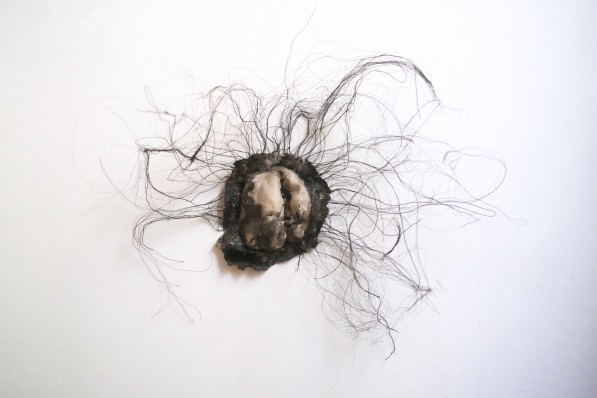
Gaëlle Chotard
Dans chaque coquillage
il y a le noir de la mer (1)
{In every seashell, there is the blackness of the sea}
November 7, 2026 – January 9, 2027
Opening on Saturday 7 November, 3pm - 8pm
"If you opened people up, you’d find landscapes.
If you were to open me up, you’d find beaches”
Agnès Varda, *Les Plages d’Agnès* (2008)
Gaëlle Chotard’s work evokes those sandy shores whose gentle slope (2) subtly draws the gaze toward the depths of the sea, where beings retain the traces of their first impulses. For her sixth solo exhibition at the Papillon Gallery, the artist seeks more than ever to capture the mystery and complexity of elementary forms of life, whose abysses could constitute a seminal landscape. By revealing this poetry of the depths, she confronts the audience with the spectacle of contingency they are made from, awakening within them a tragic consciousness (3) and the sense of awe that is associated with it. Here we see crocheted sculptures made of metal wire, compositions of piano strings and scythes, torn drawings in India ink and watercolor, and volumes of plaster and paper covered in graphite or soapstone. Each of her experiments creates a tension between structure and chance to better reveal the abyssal plasticity of beings. Returning to a darker, deliberately murky, even unsettling palette, the artist orchestrates a fleeting descent into a secret inwardness that seems to touch the very core of the world.
A haven for the most archaic proto- and micro-organisms, the blackness of the sea gives its image to the meanderings of a natural imagination. Make no mistake, however: Gaëlle Chotard works here to widen the gap between her biomorphic aesthetic and naturalist reference systems that struggle to express all of its uniqueness. From hollows and protrusions, to capillary filaments, from bulges and rips, to networks in the form of rhizomes, the morphology of her pieces may indeed evoke the “natural fantastic (4) » of amoebas, jellyfish, lymph nodes, exuviae, waves, or dream stones. But their sinuous lines and acentric structures, which cannot be reduced to preconceived categories, bear the mark of a spontaneous and unruly energy. Simultaneously resembling everything and nothing, they appear captured in the very moment of their emergence, reflecting the urgency of being that animates living things and compels the artist to create. By relinquishing some of her authority, Gaëlle Chotard restores the material to its undisciplined state, seeing the images and the means of their autonomy in these marks which spread freely across the surface of soaked paper or in a haphazard tangle of copper threads.
The hollow of a seashell is also an abyssal void. Working at the intersection of graphic art and sculpture, Gaëlle Chotard reminds us that every line is a way of tracing gaps, and that sculpture is a play of reliefs which, in negative, reveals hollows. With a keen, intimate awareness of the principle of destruction that governs the economy of the living, she, too, operates through ruptures and erasures, alternating between the gentleness of certain processes (crocheting, assembling, letting go) and a certain violence in other gestures (ripping, hammering) to give a voice to loss. The holes in the mesh, the interplay of transparency and shadow, as well as the ethereal gradations in these drawings, much like the clumps of wool tossed by the wind that left a lasting impression on her during a recent stay in the Irish moors, Gaëlle Chotard forms a landscape from these tenuous, chaotic forms that lie at the root of all metamorphoses, representing that almost nothing in which everything is still possible.
Florian Gaité (October, 2026)
(1) The title is taken from the verses of Alda Merini, Italian poet whose poems were accompanied by the artist’s drawings in an edition of Aphorisme et grigris (Cassis Belli, 2020).
(2) The etymology of “plage” is borrowed from the Italian piaggia (“slope,” “shore”), itself derived from the Ancient Greek plágios, meaning “oblique” or “inclined.”
(3) This is how Clément Rosset describes the thoughts of someone who is fully aware of primordial chaos and the fundamental meaninglessness of existence (citing Montaigne, Schopenhauer, and Nietzsche).
(4) The expression comes from Roger Caillois, who sees in it the manifestation of the strange lurking at the heart of natural laws—an infinite source of poetic inspiration.
Gaëlle Chotard - Born in 1973 in Montpellier. Lives and works in Nogent-sur-Marne
Represented since 2007
Key Dates
1998 Graduated from the École des Beaux-Arts in Paris.
2001-2002 Residency Programme à la carte in Peru, culminating in two exhibitions at the Galerie L’Imaginaire of the Alliance Française and at the Museo de Arte de Lima, Peru.
2007 Au fond, first solo exhibition at Galerie Papillon, Paris.
2006 Residency at the Espace d’Art Contemporain in La Rochelle, followed by the solo exhibition Trouble.
2013 Participated in the exhibition Dans la ligne de mire at the Musée des Arts Décoratifs in Paris.
2016 Expérience Pommery #13 Gigantesque !, Domaine Pommery, Reims
2017 Interstices, solo exhibition at the Villa Tamaris Art Center, La Seyne-sur-Mer.
2018 Ce qui me traverse, solo exhibition at the Drawing Lab, Paris, and 4th solo show at Galerie Papillon.
2022 Frémissements, fifth solo show at Galerie Papillon, Paris.
2023 Solo exhibition Dérives et surgissements at the André Malraux Contemporary Art Space.
2025 Solo exhibition La peau de l’oiseau at the Creux de l’Enfer, Thiers.
In the collections of the Cnap - (Fonds national d’art contemporain) and the Fonds régional d'art contemporain Normandie Rouen.